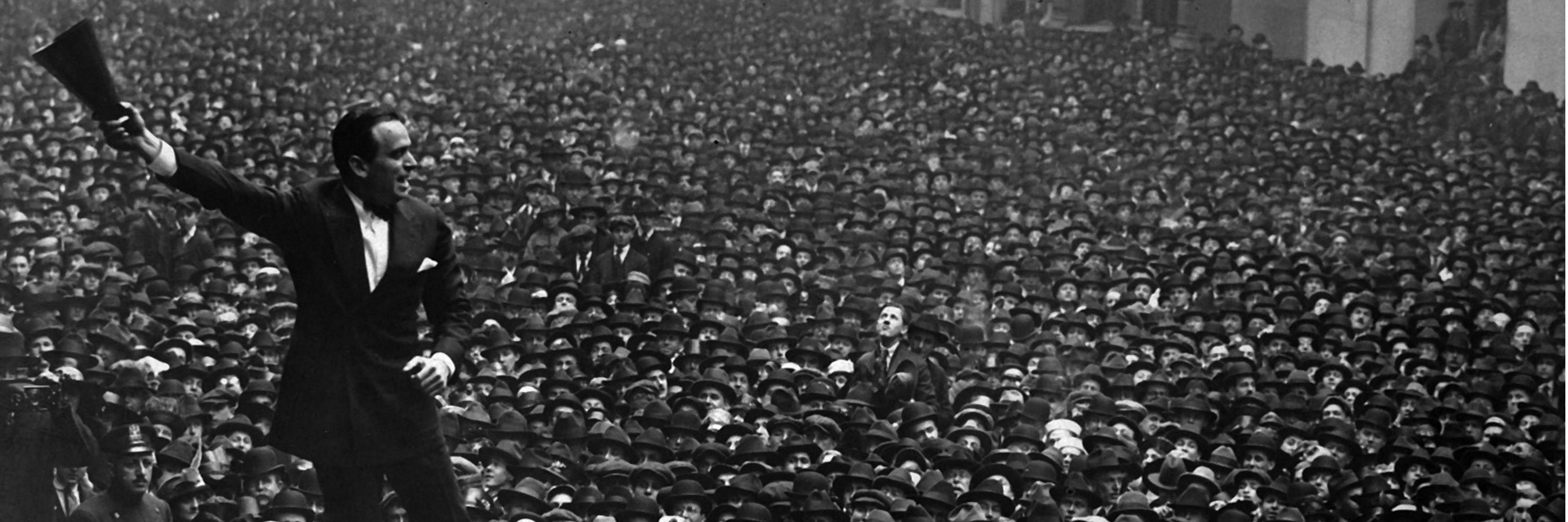
“Are you ready?” Donald Trump demanded of the crowd during a recent rally. “Are you ready?” The crowd howled its assent. Trump was stoking anticipation before reiterating one of his most prominent and least plausible campaign pledges: to build a wall between the United States and Mexico and make Mexico pay for it. Such call-and-response exchanges have often featured in Trump rallies (for examples, see the January 7, 2016 rally in Burlington, Vermont and those in Tampa on February 12 and Greenville, North Carolina on June 14 and September 6). With these exchanges, Trump presents himself in conversation with his supporters — a conversation without disagreements or misunderstandings. The conversation is not spontaneous, and the rally attendees are not equal participants in it: Trump, not the crowd, leads the call and response, which have become, as Ryan Lizza notes, an oft-rehearsed, well-recognized part of the repertory of a Trump rally. Nevertheless, during the call and response Trump’s speech appears perfectly aligned with that of the crowd — the crowd literally finishes his sentences for him. Such moments foreground one of the Trump campaign’s central claims: that Trump’s relationship with the American people overleaps mediating political institutions. Trump uses this claim to further an illiberal, anti-democratic politics. The dramatization of similar claims via rallies, however, is ubiquitous in American presidential campaigns.
As many commentators have observed, Trump presents himself as a populist. Populism has a long history in U.S. politics, flaring up in the short-lived People’s Party (1891–1908), the rhetoric of Depression-era firebrands Huey Long and Father Coughlin, and in the failed presidential bids of George Wallace and Ross Perot (to cite just a few examples). Often mixing elements of left- and right-wing ideology, populism locates political virtue and legitimacy in the people, regarding elites and their values as corrupt. As Margaret Canovan and Nadia Urbinati have noted, populism rejects political institutions that mediate between the people and political power. Urbinati writes: “[T]he populist interpretation conceives of democracy as a principle and an attempt to achieve an immediate identity of governed and governing. Both the claim for a direct relationship between people and leaders and the claim for popular, direct participation reveal a distrust in the forms and institutions of representation.” Trump plays into the populist skepticism toward institutions and representation. He touts himself as flouting the Republican Party organization, feuding with and temporarily withholding endorsements from the party’s leaders. He boasts, falsely, of self-funding his campaign and thus avoiding the corrupting influence of wealthy donors and super PACs (see, for example, the August 5 rally in Green Bay, Wisconsin).
Although populist rhetoric calls for restoring political power to “the people,” populist political movements, as Canovan observes, can “encourage support for strong leadership where a charismatic individual is available to personify the interests of the nation.” Presidential campaign rallies evoke this personalized form of leadership. At rallies, political power, or potential political power, coalesces in an individual — the candidate. As I note in a previous essay, presidential campaigns portray rally crowds as surrogates for the American people as a whole. Given that these crowds are almost entirely filled by candidates’ most enthusiastic supporters, they evoke a citizenry whose beliefs and goals overlap with the candidate’s own. Rally crowds cheer candidates’ statements and laugh at their jokes. Rallies thus present an ideal relationship between the (potential) political leader and public in which all differences of opinion between the two are erased. Much of the complex apparatus of politics and governance — the lobbyists, the super PAC donors, the Congressional subcommittees — falls away. Members of Congress and state and local party officials may address the crowd before the candidate appears. These individuals, however, only serve as opening acts, creating a momentum that peaks with the candidate’s speech. Candidates sometimes choose to share the stage with individuals whose support they wish to draw attention to. More often, however, the candidate speaks alone. Rallies present a drama with just two main characters — the candidate and the crowd. All intermediaries dispensed with, the crowd comes face to face with the individual who holds, or hopes to hold, the most powerful office in the world.
Urbinati and Canovan note that this vision of the leader-people relationship keeps uneasy company with liberal democracy. As Canovan writes, “The preference for direct personal representation over elaborate mediating institutions…gives the leader of a populist movement a degree of personal power that is hard to reconcile with democratic aspirations.” Yet while campaign rallies’ staging conflates the identities of leader and people, most presidential candidates do not make this conflation a centerpiece of their campaigns, or even of the speeches they give at rallies. When Clinton discusses her past political achievements or future plans, she often describes herself collaborating with other political actors. At an event in Reno, Nevada on May 5, 2015, she told the crowd: “I want to work across party lines, I want to work with the public and private sector, I want people to get back to the good old-fashioned American style of problem solving.” Clinton made similar claims in an April 2, 2016 speech: “I’m running for president to be a good partner…with people all over our country, in elected positions, in business, in unions, in academics, in civic organizations, in education.” In her speech at the Democratic convention, Clinton described her work with the Children’s Defense Fund: “[W]e gathered facts. We built a coalition. And our work helped convince Congress to ensure access to education for all students with disabilities.” Later in the speech she declared her intention to “work with both parties.”
Clinton has been a prominent figure in Democratic politics for twenty-five years; it would be difficult for her to convincingly assume the role of uncompromising outsider even if she wished to. However, even 2016 candidates who have claimed to challenge party or economic elites have nonetheless suggested that they did so in concert with other political actors. In victory and concession speeches, they thanked state and national politicians who backed them and the staff and volunteers who worked on their campaigns (see, for instance, Ted Cruz’s speeches after the Iowa Caucus and Super Tuesday, as well as Bernie Sanders’s speeches after the New Hampshire and California primaries).
Where Trump diverges from other candidates is in his assertion that only he, on his own, can embody the people’s will. Trump staked out this claim in the speech announcing his candidacy: “[O]ur country needs a truly great leader, and we need a truly great leader now. We need a leader that can bring back our jobs, can bring back our manufacturing, can bring back our military, can take care of our vets.” Trump has reiterated variations on this assertion throughout his campaign. In a June 22, 2016 speech in New York City, he proclaimed: “When I see the crumbling roads and bridges, or the dilapidated airports, or the factories moving overseas to Mexico, or to other countries, I know these problems can all be fixed, but not by Hillary Clinton — only by me.” At his rallies, Trump sometimes spins out a scenario in which, as president, he personally calls the heads of companies planning to build factories in Mexico and threatens to impose a thirty-five percent tariff on their goods if they do so (see, for instance, rallies in Portland, Maine on March 3 and Spokane, Washington on May 7. In this fantasy, the CEOs cave and Trump singlehandedly restores the U.S. manufacturing sector to its former glory. The Republican convention hammered home the myth of Trump’s omnipotence. Trump declared: “I alone can fix” a rigged political system, a claim that the convention’s visual elements reinforced. As Margaret Rhodes noted at Wired, booths near the state where party leaders were seated were darkened, focusing attention on the onstage speaker; by contrast, the Democratic convention featured lighted booths, framing the party leadership as a collective. Trump made his first entrance onto the convention stage in silhouette, accompanied by a fog machine. Trump the individual, with his orange tan, gold wig, and braying voice, was subsumed in Trump the messianic leader. Though it drew humorous comparisons to WWE showmanship, the entrance played into the Trump campaign narrative in which a single, extraordinary individual emerges to embody the people’s will and thus right the ship of state.
Trump has pulled this narrative from the periphery to the center of American political discourse. He treats alternate sites of political power — Congress, the judiciary, state and local government, the Democratic party, interest groups, even most Republican party officials and operatives — as irrelevant or illegitimate. Seizing on the campaign rally’s promise of a non-representational, populist politics, Trump stages a vision of leadership unfettered by democratic checks and balances.

 Monica Achen