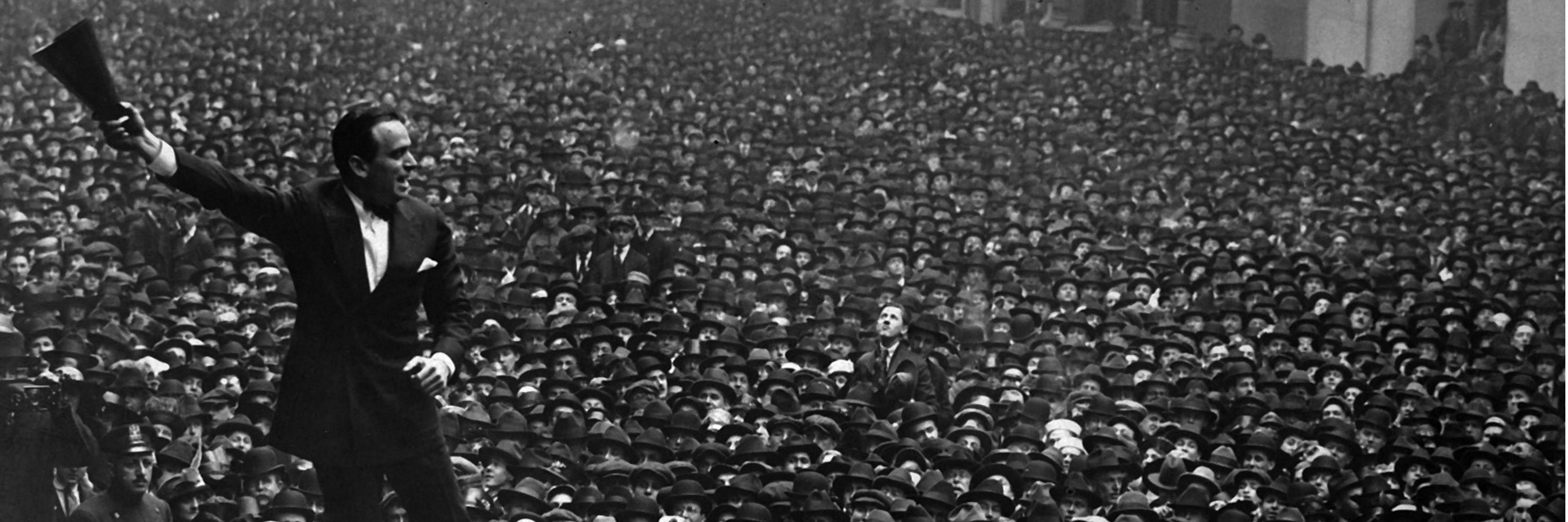
Donald Trump’s rallies draw their energy and mood as much from the crowd as they do from the candidate. Crowds routinely interrupt Trump’s speeches by chanting “Trump, Trump, Trump!” or “USA! USA!” One journalist attending a rally noted “a building sensation of togetherness, rolling vibrations of solidarity and giddiness and anticipation.” Another quotes a rally attendee: “[I]t feels good to be around people who think the same as you, who are fed up.” The same article describes the crowd gesturing and singing in unison as Trump takes the stage. A Trump supporter “held a black-gloved fist in the air for a long while. The man next to her in the leather jacket held his fist up, too, and there in the middle-right section of the crowd, people began singing or mouthing the chorus, “We’re not gonna take it — anymore!” Chanting and gesturing in unison, Trump’s supporters temporarily subsume their individual identities to that of the group. Their synchronized speech and gesture evokes as an idealized version of the American people in which no meaningful differences or conflicts exist. Trump’s rallies reinforce this ideal through the ritualized exclusion and expulsion of dissent. The ideal itself, however, is a core theme of presidential campaign rallies and U.S. politics.
Virtually all presidential campaign rallies present the candidate’s supporters as a unified, harmonious collective. Attendees are packed into an enclosed space: no walls separate one from another, and each can see and interact with his or her neighbors. The campaign rally starkly contrasts with the most symbolically weighted political action in representative democracy — voting. Although most voting takes place in public places — polling stations — it is in some ways a private act. The secret ballot dictates that each voter cast his or her vote alone, in a voting booth whose curtain or walls screens the voter from the eyes of fellow citizens. The voter may encounter many other members of the public while waiting in line and obtaining his or her ballot, but the climax of democracy’s central ritual foregrounds the individual citizen, acting alone.
By contrast, enthusiastic expressions of solidarity are common to most campaign rallies. Watch footage from the rally of any 2016 Republican or Democratic presidential candidate, and you will hear the crowd cheering the candidate, chanting his or her name, and waving identical signs that the campaign has distributed. The level of enthusiasm may not rise as high at a Clinton rally (or at rallies held by Trump’s Republican former rivals) as at a Trump rally. But these disparate candidates’ crowds clearly share a repertoire.
Most rally attendees are among a candidate’s most ardent supporters — after all, attending a rally takes time and effort. Rallies’ primary audiences, however, are not the crowds in attendance, but the vastly larger number of undecided or unmotivated voters watching them unfold on television, in YouTube clips, or via social media. Thus, campaigns present rally crowds as a microcosm of America that potential supporters can see themselves as part of. Many campaigns ensure that the subset of crowd members who stand behind the candidate, and thus appear on camera, includes an equal gender distribution and a diverse array of races and ages. Not only can television viewers see their own identities reflected in the crowd, they can see a varied array of American identities joining together to cheer the candidate. Similarly, candidates’ speeches purport to address the public as a whole, not the segment that currently supports them. Candidates use the pronouns “we” and “us” to refer to the American people, not just the people gathered in the crowd. Trump complains that “we don’t win anymore” (his rally in The Woodlands, Texas shows one among many instances of this refrain). Clinton tells crowds, “I believe we are stronger together.” Yet the crowd, cheering these statements, stands in for the wider public and holds out the prospect that the public could embrace its joyful unity.
Presidential candidates routinely summon the ideal of the united public because this ideal sustains political leaders’ legitimacy. In theory, every holder of elected office represents the whole community of whatever geographic region that office covers. Elected officials present themselves as speaking on behalf of the people of their city, state, or country, not merely the fraction of the people (often a small one) that happened to vote for them. Citizens are expected to abide by the laws that their local, state, and national representatives make, even if they disagree with the laws and voted against those representatives. This tension is particularly apparent in the office of the president, because the president is president of the entire country. Campaign rallies strive to temporarily overcome this tension. Speaking and gesturing as one, the crowd conjures an American public that likewise acts in unison. However briefly, it bestows on the candidate the stamp of legitimacy.
The possibility of a united, harmonious citizenry is a myth. Any society — but particularly a large, diverse modern state such as the United States — contains an array of groups whose values and wishes often clash. The origins of the myth stretch back to democracy’s infancy in the seventeenth and eighteenth centuries. The historian Edmund Morgan chronicles in Inventing the People: The Rise of Popular Sovereignty in England and America how the “fiction” of popular sovereignty, developing during the English Civil War, depended in turn on the fiction of the people as a single, unified political actor. The French philosopher Jean-Jacques Rousseau argued in The Social Contract (1762) for the sovereignty of the “general will,” the people’s abstract, collective pursuit of the common good, not to be confused with the will of the majority. Calls for national unity resound through past and present American political rhetoric. George Washington, in his Farewell Address, warned against the “alternate domination of one faction over another, sharpened by the spirit of revenge, natural to party dissension, which in different ages and countries has perpetrated the most horrid enormities.” In the 1940 state of the union speech, Franklin Roosevelt decried “[d]octrines that set group against group, faith against faith, race against race, class against class, fanning the fires of hatred.” The traditional protest chant, “The people — united — can never be defeated” appeals to the same ideal that Washington and Roosevelt evoked, as does the Occupy movement’s rallying cry, “We are the 99%,” which postulates an overwhelming majority of hard-working, virtuous Americans whose opposition to the corrupt rich forges them into a single entity.
The historians Jacob Talmon and Peter Holquist, among others, have argued that, far from safeguarding democracy, the ideal of a united, harmonious citizenry contains the seeds of authoritarian politics. In “State Violence as Technique: The Logic of Violence in Soviet Totalitarianism,” Holquist observes that “totalitarianism seeks…to represent and realize the ‘People-as-One.’ It not only denies, but seeks to eliminate, all forms of heterogeneity and division.” But if the ideal of total national unity has the potential to foster authoritarian politics, that potential has remained unrealized in the campaigns of most early twenty-first century presidential candidates. Most candidates, though they hold out the ideal of a united, harmonious public, accept that the actual American public is riven by substantial conflicts and likely to remain so. Hillary Clinton evoked this paradox in a June 14 speech: “There are bound to be differences of opinion in a country as diverse and complex as ours…but I believe that, despite those differences, on a deeper level we are all on the same team.” At a subsequent rally, she remarked, “You look at our [the United States’] founders…they did not all agree. They did not even all like each other. But…they worked together.” In a speech on April 19, Ted Cruz touched on a similar theme: “The question is not whether all Americans can or will agree on a majority of issues all of the time. The question is whether a majority of Americans are hungry to rally around a set of principles larger than any single issue that a politician may use to divide us.” In practice, candidates may place limits on what kinds of difference the country should tolerate (Cruz, for example, opposes gay marriage and has called for law enforcement to “patrol and secure Muslim neighborhoods”). Most, however, at least pay lip service to the notion that the American people and their leaders should tolerate competing opinions and goals.
By contrast, Trump rallies feature symbolic purges of dissenting voices. Trump confines journalists covering his rallies to a pen, and he often points them out to the crowd before condemning them as “the most dishonest people you will ever meet” (for one among many examples, see the June 29 rally in Bangor, Maine). The crowd responds by booing the media. Because the media is a source of potential criticism, Trump isolates them from his crowd of supporters, whom he then enjoins to reject the interlopers. He also bans from his events those news organizations (the Washington Post, the Huffington Post, Univision, Politico, the Daily Beast, Buzzfeed, and the Des Moines Register) that he perceives as having unfairly criticized him.
Trump and his supporters’ response to protestors has a similar structure. Protesters often appear at presidential candidates’ rallies, and their dissent undermines the façade of unity that rally crowds offer. Some candidates ignore protestors, and some may attempt to engage them in dialogue. Trump, on the other hand, has made ejecting protestors a central ritual of his rallies. The crowd identifies protestors, pointing at them and chanting “Trump! Trump! Trump!” Trump’s security detail then forces the protestors from the rally. The crowd, embodying the Trumpian vision of the American people, casts out those who threaten political unity.
Both the myth of a harmonious national community and the exclusion of certain groups — racial minorities, LGBT Americans, women — from full participation in the community have a long history in U.S. politics. Trump could not have secured the Republican nomination and the support of millions of Americans if he did not mirror widely shared ideals and deploy easily recognizable modes of political action. Yet most presidential candidates, though they may disagree about how or in what degree to tolerate differing opinions and identities, accept such tolerance as a crucial norm of American political discourse. Trump and the crowds who cheer him rehearse that norm’s destruction.

 Monica Achen