“What we are trying to do, as part of creating a political revolution, is to create a grassroots movement of millions of people.” This sentence, or a variation on it, features in many of Bernie Sanders’ campaign speeches, advertisements, social media, and interviews. By implication, Sanders presents himself as the embodiment of this mass movement’s political hopes and desires. In other words, Sanders portrays himself both as a populist, in the sense that he claims to champion ordinary people against political and economic elites by circumventing political institutions to offer them unmediated access to a locus of political power — himself. All presidential candidates claim to represent the wishes of a majority of the U.S. population — indeed, they can only win an election if they convince a majority of at least the partial truth of that claim. But few make that claim as central to their campaign as Sanders has. In order to substantiate it, Sanders must convince supporters and potential supporters that the grassroots mass movement he describes actually exists and that they are or can be part of it. Thus, the success of Sanders’ performance as a populist hinges not only on how he portrays himself, but how he portrays his supporters. Sanders suggests that those supporters possess four key qualities: (1) their numbers are expanding rapidly; (2) they display an enthusiasm rare in American politics; (3) they represent a broad cross-section of the nation; and (4) their support is spontaneous and self-organizing.
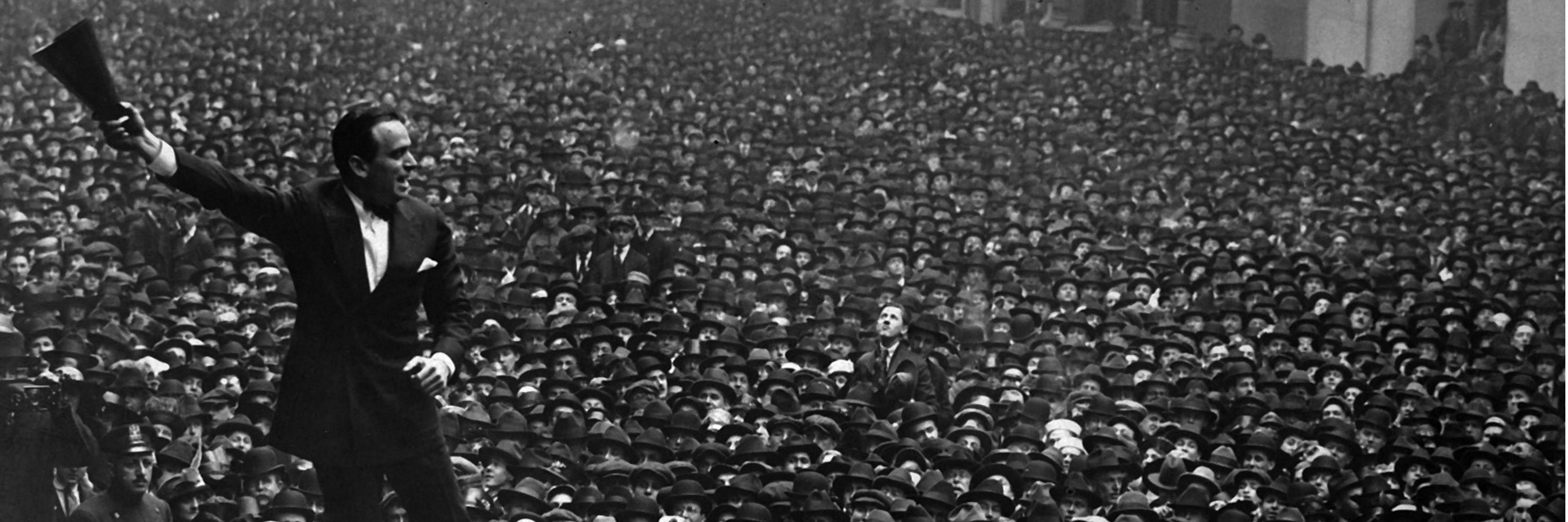
Sanders repeatedly draws attention to the rate at which his support has expanded. Around 5,000 people attended his campaign launch on May 26; as of early October, Sanders is fielding crowds of over 20,000 for his largest campaign events. Throughout the summer, Sanders often began speeches by announcing his surprise at the number of those gathered to hear him. At a rally in Madison, Wisconsin on July 1, he declared: “Tonight we have more people at a meeting for a candidate for President of the United States than any other candidate has had in 2016,” and similarly, in Portland, Maine on July 6: “In case you haven’t noticed, this is a big turnout.” At a rally in Portland, Oregon on August 9, Sanders, wide-eyed, scanned the filled upper reaches of the arena, before announcing: “Woah! This is an unbelievable turnout.”
Sanders’s crowds often overflow event venues, a fact that conveys not only their ballooning size but their members’ surging excitement. They create an impression (whether accurate or not) that the candidate has attracted even more supporters than he and his staff dared to hope. Individuals willing to wait in line for hours to pack into overflow rooms are so excited to achieve physical proximity to the candidate that they are willing to put up with considerable inconvenience even though they may not be able to watch the main event — the candidate’s speech — live. Sanders’ campaign drives home the intensity of supporters’ enthusiasm in its communications, such as this video of interviews with the creators of hand-made campaign signs, or this one in which a starry-eyed young campaign worker describes the cheers that greet Sanders every time he walks out on stage.
In addition to growing size and enthusiasm, the Sanders campaign attempts to perform expanding breadth. It has struggled to achieve diverse demographic appeal (witness Sanders’ uneasy interactions with Black Lives Matter activists and difficulties attracting non-white or working class voters). Instead, the campaign has emphasized its geographic reach. Sanders has held rallies in overwhelmingly Republican states — not only South Carolina (site of an early primary), but Georgia, Louisiana, Texas, and Arizona. Sanders has had trouble gaining traction in the South, and such campaign stops serve to undermine the suggestion that he cannot win in conservative areas. Indeed, he opens many of these rallies by marveling at the crowds’ seemingly unexpected effusions of support, though many of them are held in the Democratic strongholds of their respective Republican states. In a rally in Louisiana on July 26, Sanders remarked: “Some people told me Louisiana was a conservative state — guess not!” Similarly, in Houston on July 3, he told a crowd: “People say, ‘Don’t you know that Texas has a conservative Republican governor, two republican senators….Don’t you know, Bernie, this is a conservative Republican state?’ And my answer is yes, I do know…and that is exactly why I’m here today.”
Far-flung rallies are not the only performances of broad support that the Sanders campaign offers. Only July 29, it orchestrated over 3,000 simultaneous organizing meetings across the country; Sanders addressed these meetings via internet stream. On a map on the campaign’s Twitter account, in which a red dot represents each event, significant swaths of the country appear carpeted with them. As many of the individual events posted to the campaign’s Twitter timeline, the plethora of announced locations amplified the impression of a nationwide surge of effort and excitement.
Sanders portrays his supporters as participating in a grassroots movement, one free from the corrupting mediation of Democratic Party institutions. During the July 29 organizing event, participants photos’ on the campaign’s Twitter feed showed relatively small venues: libraries, bookstores, living rooms. One organizer exclaimed: “I didn’t know I could fit so many people into my apartment!” The event and its self-portrayal on social media suggest a candidacy supported by small groups of citizens spontaneously drawn together. Further, they present the participants as enjoying access to a candidate who addresses them directly in their own homes or neighborhoods.
Sanders has rejected Super PACs and the high-donation fundraisers that are often mainstays of national campaigns. These decisions reflect Sanders’ oft-stated revulsion at wealthy donors’ influence on U.S. politics. At the same time, by calling attention to his reliance on small donors, Sanders underscores the notion that his campaign has sprung up to fulfill the dreams of vast numbers of ordinary people. In the video “I Want to Thank You,” Sanders notes that “two hundred and fifty thousand people made contributions” to his campaign. He continues: “Yeah, I know, they weren’t million dollar contributions. They weren’t ten thousand dollar contributions. They averaged something like thirty-five dollars a piece….This campaign is being fueled by working people…and not by the billionaire class.”
By signaling who their supporters are, candidates attempt to demonstrate a key element of who they themselves are. Theater scholar Gordon Rogoff writes that “charisma is, by definition, a description of shared needs.”[1]Charisma is not an inherent quality possessed by a performer, but a relationship between performer and audience. Political candidates, even those who are not charismatic in the conventional sense, likewise perform as the avatars of shared needs. To control and succeed in their performance, they must give these shared needs a shape, presenting their audience as well as themselves with a specific role to slip into. Sanders gives his supporters and potential supporters the role of participants in a vast grassroots movement, and through campaign events, interviews, ads, and social media he reinforces that role. Only to the extent that Sanders’ supporters can embrace that role can Sanders inhabit the role he has assigned himself as the fierce populist leader revolutionizing American politics.
[1] Gordon Rogoff, “Burning Ice,” in Erika Munk, ed., Stanislavski in America: The “Method” and Its Influence on the American Theatre (New York: Fawcett, 1967), p. 264. Full disclosure: Rogoff is former professor of mine.

 Monica Achen