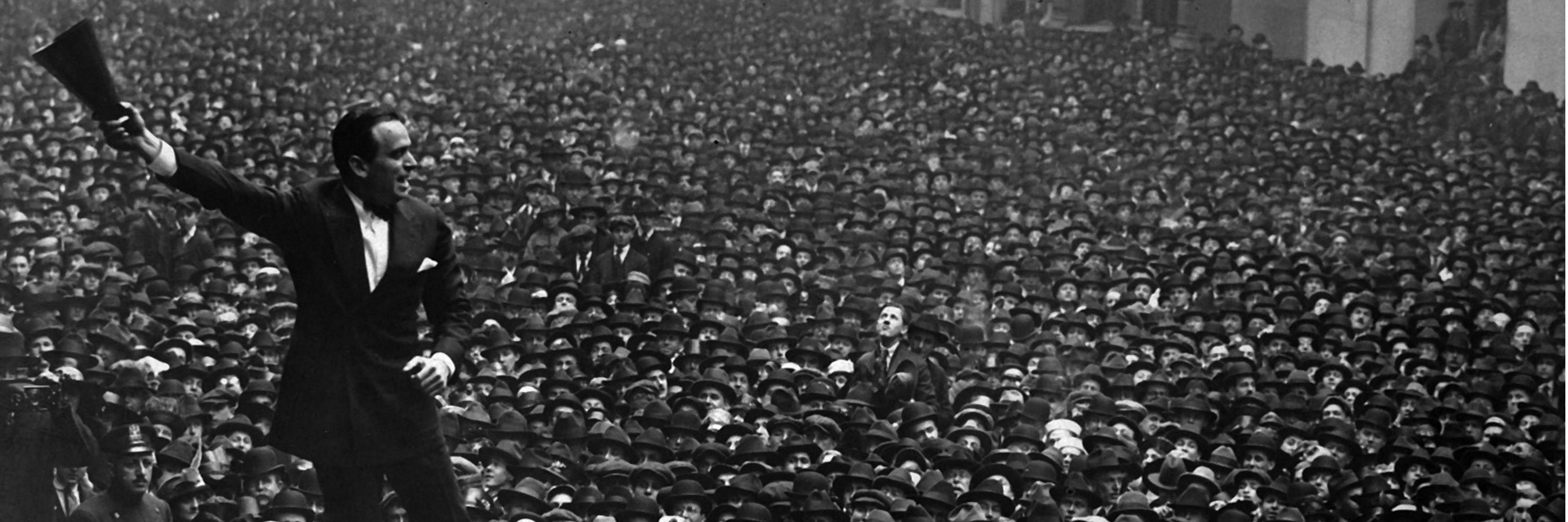
Last month, Derek Thompson, writing in the Atlantic, criticized what he called the “theater-critic” approach to political journalism: “Theater-critic journalism is certainly not as substantive as policy analysis. It’s also neither as meaty as terrific behind-the-scenes reporting, nor as harmless as anodyne horse-race coverage. It is, rather, personal opinion about a candidate’s authenticity masquerading as nonpartisan analysis of their ability to connect with voters.”
One obvious problem with Thompson’s argument is that, as Jonathan Bernstein points out, rigorous theater criticism avoids the pitfalls — celebrating authenticity as the highest good, judging performances in terms of success or failure — that Thompson believes political theater criticism stumbles into. More importantly, however, the clear separation that Thompson assumes between style and substance, theater and policy, does not exist. The policies that political actors embrace are part of the public roles they perform, and their communication of these policies to the public is always to some degree a performance of self.
Consider presidential candidacy announcements. In theory, campaign announcements are the events at which candidates introduce themselves to potential voters. In practice, by the time presidential candidates announce their candidacy, they have already been campaigning for months, if not years. Party leaders, interest groups, activists, and others who pay close attention to national politics are likely already familiar with a candidate and his or her positions. By contrast, most voters are disengaged with and uninformed about politics, and will likely only begin to pay attention to the presidential race some months after the candidate’s announcement (by which point the candidate may already have dropped out of the race). Furthermore, most political scientists recognize that neither candidates nor campaigns influence the outcome of elections as much as structural factors such as the economy and whether or not the country is at war. Contributing to winning or losing elections is not, however, the only way that political performances create political effects. Specifically, such performances may reinforce, undermine, or reinvent the political myths, narratives, and reference frames that shape how the public and political actors themselves think about politics.
Candidacy announcements — and political speeches generally — appeal to listeners by alternately offering the rhetoric of threat and salvation. Every presidential candidacy announcement for the 2016 election thus far has drawn attention to the United States’ current problems. Some of these “problems” (Obamacare, Wall Street) are regarded as such by only one party or a few candidates, but references to unemployment, excess student debt, and the ill-defined but universally reviled “special interests” appear in speeches from candidates across the political spectrum. All candidates also offer some vision of a better future (which is to say, one that they and their supporters see as better). Rand Paul notes that he wants a federal government that spends only what comes in; Ted Cruz asks his audience to imagine an America in which Obamacare is abolished; Hillary Clinton tells viewers, “It’s your time.”
However, the degree to which each of the candidates chooses to emphasize threat versus salvation varies considerably. Of the announcements thus far, Rand Paul’s and Marco Rubio’s represent the two ends of the spectrum. Paul presents himself as a political outsider and for the most part embraces rather than distances himself from his libertarian background. These two facets of Paul’s performance are linked — the libertarian wing of the Republican Party is a small and subordinate minority — which, incidentally, is the main reason that Paul has virtually no chance of winning the nomination.
The most striking thing about the Paul announcement is the extent to which the candidate frames himself in the negative — that is, he presents what he’s against (the national deficit, the “Washington machine,” career politicians, oversees national building, the NSA) not what he’s for. This impression is reinforced by the non-written aspects of Paul’s performance. The wall behind Paul is dark blue and, despite the American flags hanging in front of large swaths of it, Paul’s black suit — and thus Paul himself — appear to be half swallowed up by their setting rather than set off by it. The red tie that matches the red stripes in the flag adds to this effect. Additionally, Paul’s intonations and body language suggest a figure simultaneously prickly and ill at ease. When he raises his voice, it tends to suggest irritation rather than an attempt to rally the troops. At moments of emphasis, his lips purse; he responds to applauses with a brief, tight smile. Paul’s dour rhetoric and demeanor imply that the nation’s present circumstances leave little room for optimism.
In contrast to Paul, Rubio in his announcement portrays himself as the avatar of hope for a more prosperous, equitable, yet socially and fiscally conservative future. Rubio is, at forty-three, young by the standards of presidential candidates, and the role he performs throughout the speech is that of the leader of a youthful, energetic, multicultural Republican party striding confidently forward. When Rubio tells his audience that “yesterday is over,” he presents himself as a challenger to his party’s frontrunner, Jeb Bush, the sixty-two year old scion of one political dynasty, while implying that he could offer a similar, effective challenge to the scion of another political dynasty, the sixty-seven year old Clinton.
Rubio uses his personal history — as the successful child of poor immigrants — to underscore the contours of the role in which he has cast himself. When he declares that “this country is about the future,” it is by implication a future that fulfills the mythology of the American dream, in which the children of “bartenders,” “single mothers,” and “landscapers” can, through their own hard work, climb to the top of the social heap. The setting in which Rubio presents himself reinforces both positive tone of his performance and the alignment of Rubio the individual with his public role. He gives the speech in the Miami Freedom Tower, once the federal processing center for Cuban refugees, standing in front of a white background with his campaign logo scattered across it. In that logo, the slogan “A New American Century” appears underneath his name, to which a rounded, lower-case font lends an air of informality, while its combination into a single word reframes the individual who possesses that name as a political brand.
In the months ahead, I plan to write more on political performances in the 2016 presidential election. Politicians are but one subset of political performers, and presidential candidates are a tiny subset of that subset. Their activities, however, are among the most easily accessed of political performances, because they are so often recorded and widely distributed. Observing these performances, I plan to ask of them the questions I would ask of any performance: Who are the performers? What props to they use? Do they use a script and if so, what is it? How do they move (or not)? What do the sets and costumes look like? Who is in the audience? How does each of these components interact with the others? How does this performance echo or respond to other performances, past and present? If politics is theater, then what kind of theater is it, and why does that matter?

 Monica Achen